Search
-
 September 25, 2025
Sesquicentennial: second of two in a series
This is the second of two stories leading up to the October celebration of the sesquicentennial – 150 years – of the Catholic Church in Oklahoma.
SHAWNEE – Near the Abbey Church at Saint Gregory’s Abbey in Shawnee stands a monument of carved Oklahoma granite. Under the gaze of a statue of Saint Benedict of Nursia, the monument depicts the state of Oklahoma with the location of some 41 parish communities founded by the pioneering Benedictine monks who first arrived in Indian Territory in 1875.
The monument and statue taken together memorialize the complexity of the charism embodied by the monks of Saint Gregory’s since their foundation.
“At its heart, Benedictine monasticism is a contemplative way of life centered around a communal life of prayer and work,” said Rt. Rev. Lawrence Stasyszen, O.S.B., abbot of Saint Gregory’s Abbey. “That being said, from time to time the Church has called upon monks to serve actively beyond their monasteries. This certainly is true of Benedictines in the United States.”
The first Benedictines came to the United States from Germany and Switzerland in the middle of the 19th century, settling in western Pennsylvania and southern Indiana to form and to provide German-speaking priests for Catholics who had settled in those parts of the country. The Benedictine monks and sisters who came to Indian Territory similarly were called upon to serve as missionaries beyond their monasteries in pastoral care and education.
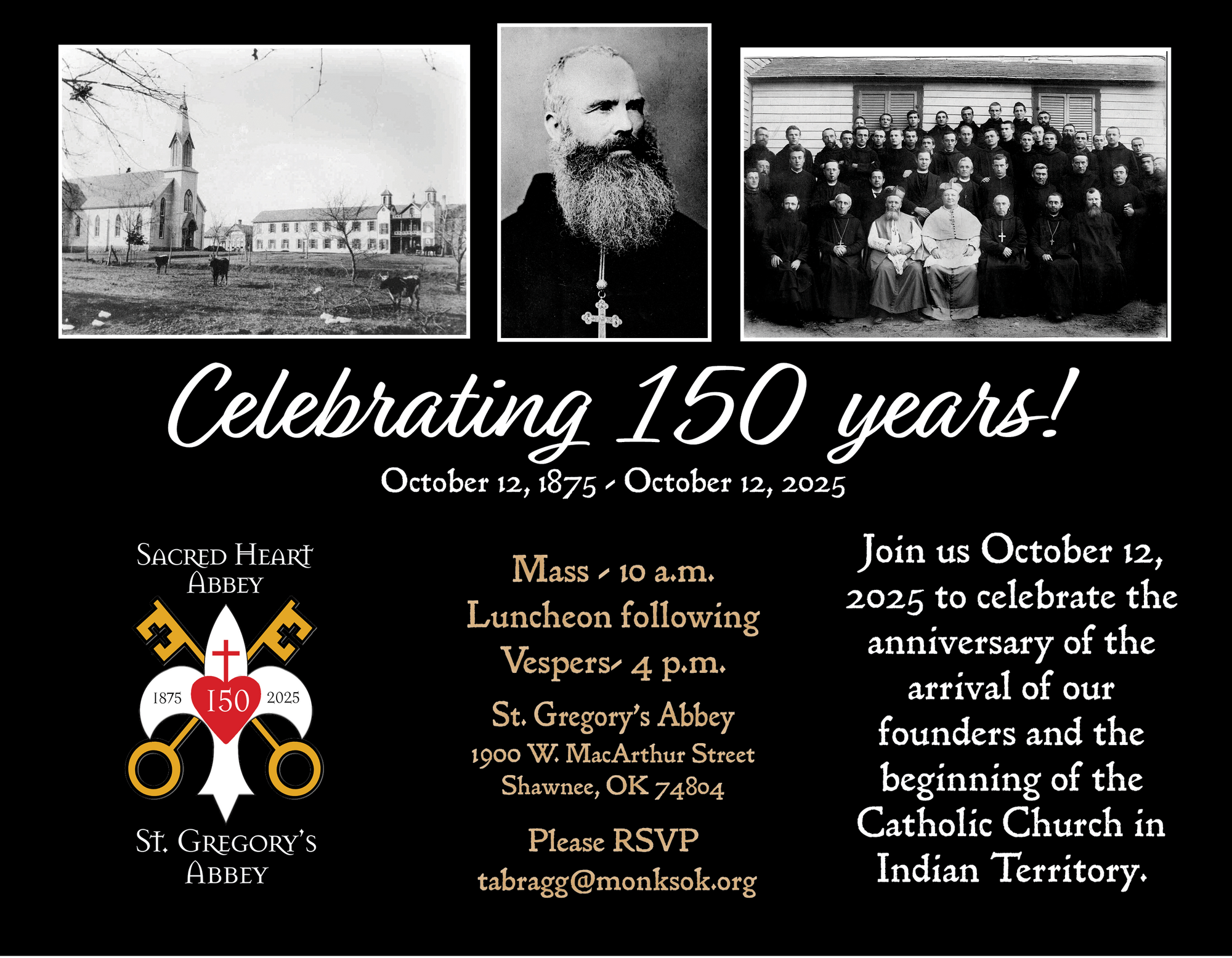
Pope Pius IX established the Prefecture of Indian Territory on May 14, 1876, creating a new jurisdiction within the Church. Although Father Isidore Robot, O.S.B., had arrived in the territory on Oct. 12, 1875, the decree appointing him as prefect apostolic was not issued until July 8, 1876. He served both as founding superior of Sacred Heart Monastery and as prefect apostolic for eight years.
“Our founders accepted what might have seemed an impossible task,” Abbot Lawrence said. “On the one hand, they sought to establish a stable monastic community of strict observance in a sparsely populated land. On the other hand, they sought to establish and support the structure of the Prefecture of Indian Territory to meet the pastoral needs of Catholics scattered over a territory nearly one-third the size of their native France.
“Tension inevitably arose between these two objectives as the needs of both were great and the number of monks were few.”
Even with such challenges, Father Isidore worked to lay the foundation of the new prefecture, exploring locations for parishes, getting to know numerous American Indian communities, and facing the resistance of government agents who were hostile to the establishment of the Catholic church in the region.
Father Isidore’s European superiors eventually realized that he needed relief from the burdens he carried. Father Thomas Duperou, O.S.B., arrived from France at Sacred Heart Monastery on Dec. 7, 1884, and assumed the role of superior of the monastic community. Of Basque heritage, Father Thomas eventually became the first abbot of the community in 1896.
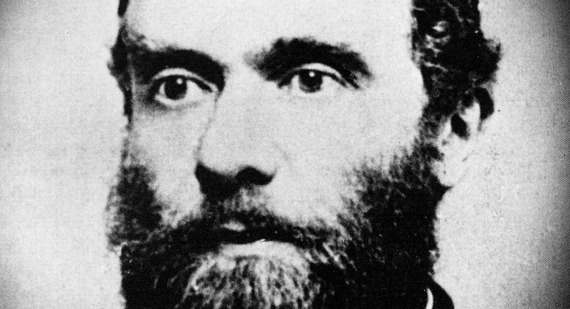
Father Isidore then was succeeded as prefect apostolic in August 1886 by yet another Benedictine, Father Ignatius Jean, O.S.B., of the French Abbey of Saint Benoit-sur-Loire. Father Ignatius continued the work of expansion, founding parishes and schools in the Osage Nation and at Chickasha, Anadarko and Purcell.
It was at Purcell that Father Ignatius preached a powerful sermon on the eve of the first land run on April 19, 1889. Admonishing the white settlers to respect the rights and dignity of the American Indians whose land they were about to claim, he said: “It is time for the American people to repair the many wrongs committed against the poor Indians. It is especially in the Indian Territory that such a reparation should be fully and completely made through a mild and truly Christian legislation, and by allowing the true friends of the Indians, prevented for so many years to do anything for them, to work in their behalf.”
When Father Ignatius suddenly was called back to France in March 1890, Father Thomas Duperous, O.S.B., administered the Prefecture from Sacred Heart Abbey until the arrival of Bishop Theophile Meerschaert in fall of 1891. The new bishop had been appointed vicar apostolic of Oklahoma Territory in April of that year. The Benedictines continued to serve a collaborative role with the new bishop and the many diocesan priests that Bishop Meerschaert recruited to serve the growing Catholic population.
Despite their limited resources, the monks had a far-reaching impact on the territory entrusted to them. In addition to the monastery and school at Sacred Heart among the Citizen Potawatomi in the central part of the territory, they founded parishes from Pawhuska and Hominy Creek among the Osage in the northeast, to Krebs and McAlester among the Choctaw and the Italian and Polish miners in the southeast, to Anadarko in the southwest to serve the Apache, Arapaho, Caddo, Cheyenne, Delaware, Kiowa and Wichita, who had been confined to reservations around Fort Sill.
In these locations they established schools to be staffed with the invaluable assistance of religious sisters.
The first group of sisters to reside in Indian Territory were the Benedictine Sisters of Perpetual Adoration of the Blessed Sacrament. Like the monks, these sisters first came to Louisiana in 1872, where they taught African American children. They began teaching at Sacred Heart Mission on Sept. 27, 1880.
However, they found it impossible to maintain perpetual adoration of the Blessed Sacrament along with their teaching responsibilities. They returned to Louisiana in 1884. Immediately taking their place were Sisters of Mercy from Macon, Illinois. Mother Mary Joseph Shields, R.S.M., led four other sisters to their new home in Indian Territory.
Describing their first impression, one of the sisters later wrote, “We suddenly came into view of the convent with its surrounding groves and fields – the latter in waving grain; the monastery to the right – all presenting a grand surprise and delight to our longing eyes.”
The motherhouse of the sisters remained at Sacred Heart until 1905, until it was moved to Oklahoma City. The congregation eventually founded and staffed 10 other schools. Their legacy continues at Mount Saint Mary Catholic High School in Oklahoma City, as well as in the Mercy Hospital system based in Oklahoma City.
When Prefect Apostolic Ignatius Jean, O.S.B., and Father Felix DeGrasse, O.S.B. were allowed to respond to the requests of the Osage Nation for parishes and schools, they looked to Saint Katharine Drexel for help in securing religious sisters for the mission. Through her intercession, the Franciscan Sisters of Glen Riddle, Pennsylvania, agreed to come to Pawhuska, arriving on Oct. 22, 1887.
The monks and the sisters worked together to establish and staff Saint Louis School for girls in Pawhuska and Saint John’s School for boys on Hominy Creek to the south. This effort began a long association between these missionary Franciscan sisters and the Benedictine monks that included the establishment of successful schools in Purcell, Chickasha and Anadarko.
Saint Patrick Mission and School in Anadarko proved to be one of the most successful. Founded by Father Isidore Ricklin, O.S.B., the Franciscan sisters served there alongside the Benedictines for 60 years.
Prefect Apostolic Jean likewise invited Benedictine women to the newly opened Oklahoma Territory when he contacted the Benedictine Sisters of Saint Joseph in Creston, Iowa. Under the leadership of Mother Paula O’Reilly, O.S.B., the first sisters from Iowa established their convent and ministry in Guthrie, Oklahoma Territory, in September 1889. Three years later, the entire motherhouse of more than 30 sisters moved from Iowa to the new territory.
This community of devoted Benedictines has had a profound impact on the development of the Church in Oklahoma and continues is life of prayer and service at Saint Joseph Monastery in Tulsa.
In 1910, the monks at Sacred Heart agreed to establish a high school and university in the prospering city of Shawnee, some 30 miles to the north of their original mission. The combination of high school and university were placed under the patronage of Saint Gregory the Great and opened to great fanfare in September 1915. The new institution soon became the primary center of activity for the monks.
In 1925, the monks decided to transfer their monastery from historic Sacred Heart to the commercial center of Shawnee, assuming the new name of Saint Gregory’s Abbey. It is there that the monastic community continues in its journey of consecrated life.
“Our community has responded to many needs over our first 150 years of history,” Abbot Lawrence said. “By God’s grace and the support of many people, the dedicated monks of each generation have produced great fruit in the areas of pastoral ministry and education.
“We now are in a new period of history, and we continue to listen to the promptings of the Holy Spirit, the needs of the Church, and the voices of a new generation, to discern how we now are being called to serve the mission of the Church.”
Photo: (Above) Fr. Ignatius Jean, O.S.B.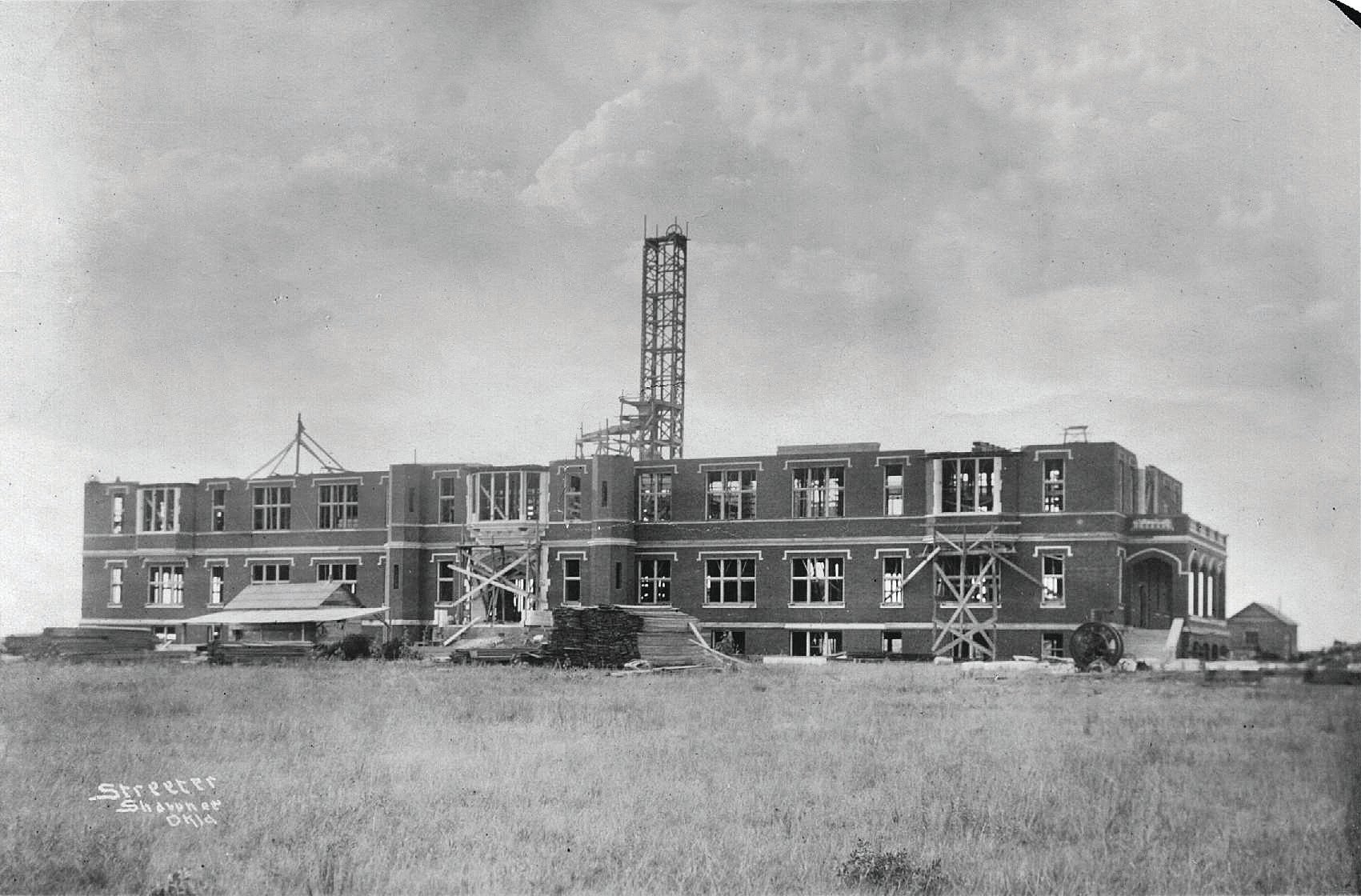 Construction of Benedictine Hall in 1914. Photos St. Gregory’s Abbey archives.