
Search
-
 November 5, 2025Catherine Mardon, as they say, knows people. Some famous. Some far from any spotlight. And many in between. And she mixes with them all quite well.
Mostly these days, she’s drawn especially to the most marginalized.
Committing her life to social activism and serving as an advocate for the disenfranchised, including the homeless and those with AIDS, disabilities and Fetal Alcohol Syndrome, Mardon isn’t one to preach, yet stands united with those suffering or in need of help.
Mardon, an Oklahoma native whose early formation took shape in the state, now calls Alberta, Canada, home. A writer and former lawyer, Mardon’s diverse academic background includes degrees in agriculture, arts, theological studies and law.
“I grew up going to Saint James the Greater Catholic Church in Oklahoma City, a place that really formed me as a child,” said Mardon. “We were very poor growing up in Oklahoma and my parents instilled in me very early a sense of volunteerism.
“Our church burned down in the early 1970s when I was in the third grade, a very surreal event, in which I had to help with my family to fundraise to rebuild it. We hosted lots of bingo nights, which was actually illegal at the time in Oklahoma due to gambling restrictions, so we had to put up blackout curtains in the school cafeteria and the doors would get locked in the event we got raided.
“This was a major coming-together that had a lot to do with my early formation as a child and the need to give back and help rebuild a community.”
Owning a fascinating background, marked by colorful situations and dotted with historic figures, Mardon has a story to tell due in part to her experiences.
One such experience: an encounter with an Oklahoma priest in Guatemala. Yes, Blessed Stanley Rother.
“I have had the opportunity to meet some really incredible people,” said Mardon. “I met Blessed Stanley Rother in 1976 on a mission trip I went on with Carmelite nuns. My first vision of him was on the roof of his rectory in Guatemala.
“We traveled with the Sisters of Mercy out of Wichita, Kansas (the nuns who taught at Saint James the Greater Catholic School), and the Carmelite nuns joined us. I thought to myself ‘Who is this guy on the roof?’ He took his hat off and wiped his forehead and the sun shone through his hair and it was bright red with the sun beaming down on it. And I thought, ‘That’s not a Hispanic or Mayan person.’
“I’m very tall – nearly 6-feet tall at the time – and I’m typically a head taller than most Hispanic or Mayan people. Blessed Stanley towered over all of them as well.”
Mardon said she witnessed Blessed Stanley as a servant committed to helping others by utilizing his personal gifts through creativity and problem-solving.
“Blessed Stanley represented everything growing up in Oklahoma was all about – hard work,” said Mardon. “Being raised so poor, we either made do or we did without. We learned to fix things because we couldn’t buy things. Blessed Stanley would fix the roofs and tinker everywhere I saw him. From what I witnessed, he applied that hard-working attitude while serving the people.
“He was always puttering and fixing things in Guatemala, and he helped the people increase their crops due to his vast knowledge-base.”
With a mother who was raised Baptist and converted to Catholicism for marriage, Mardon said her mother didn’t want her to become a nun, instead pushing her to become a doctor or a lawyer.
“I had an early fascination with nuns, and the way they lived,” Mardon said. “My mother approved of Catholicism, of course, but since my grandmother was upset she married a Catholic, my mother very much was against me becoming a nun. However, my grandmother finally relented that I did indeed ‘get a very amazing education from those nuns.’”
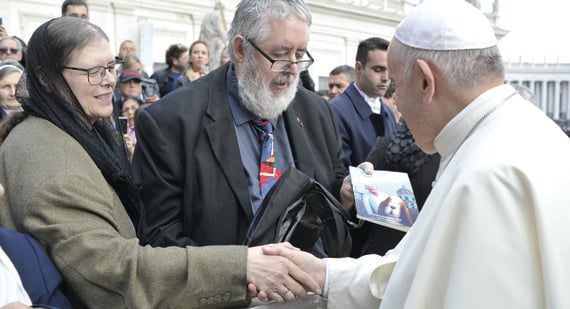
Mardon had the opportunity in 1979 to witness Saint John Paul II (Pope John Paul II at the time) celebrate Mass in Mexico City. She also received a 20-minute audience with Pope Francis, while presenting her book “Curveballs,” her true story of faith amid adversity, in November 2019.
“I was asked to go on a trip to see Pope John Paul II lead an enormous Mass in Mexico City,” Mardon said. “I told my mom I was going to a math competition as a coverup. Looking back, can you imagine if something had happened and my mother was notified I was actually in Mexico City?”
Her life took a profound turn in 1991 when she was the subject of a severe attack for her activism, an event that led her from law to fervent advocacy for the disabled. The attack, which took place while she provided testimony against the leader of a white supremacist group, left her with physical injuries, a traumatic brain injury and PTSD.
Recognized for her resilience and contributions with awards like the Diamond Jubilee Medal and the Sovereign’s Medal for Volunteers, Mardon has also been a pivotal figure in the Catholic Women’s League and the Veterans of Foreign Wars Auxiliary.
She and her husband, Austin Mardon, Ph.D., are both respected academics, well-versed in the variety of mental illnesses and strong activists for social justice.
Austin Mardon first pursued a degree in geography, joining a NASA-sponsored Antarctic expedition which began his journey as an Antarctic explorer, founding the Antarctic Institute of Canada (AIC), which initially marked the onset of his mental and physical health challenges.
Diagnosed with schizophrenia at 30, this sparked his advocacy for mental health awareness, inspiring him to obtain master’s degrees in science and education, and a Ph.D. in geography.
Recently elected as a Foreign Fellow of the Indian National Science Academy (INSA) – one of India’s most revered scientific institutions – Austin, however, claims a bigger accomplishment: his marriage.
“We were married in 2003,” Austin said. “Most schizophrenic people do not marry. Even after receiving all of these awards the biggest award I have ever received is marrying Catherine.”
In 2017, Catherine and her husband were inducted into the Order of Saint Sylvester for their work with disability and mental illness advocacy, as well as management of several activism campaigns. The Pontifical Equestrian Order of Saint Sylvester Pope and Martyr is one of five papal knighthoods officially overseen by the Holy See as orders of merit for clergy and Catholic laity.
Previously facing personal challenges after not being able to have children on their own and not able to privately adopt, the Mardons chose foster care as their calling.
“The kids we help are thrown out by society,” Catherine said. “Their families only want something to do with them when they receive disability checks. We are taught that every human life intrinsically has the same value. We are looking at children whose parents abused them when they were in the womb (Fetal Alcohol Syndrome). It has become our passion to help these children and young adults.
“These kids have been thrown away, by their friends, family and society. When kids age out of foster care, many of them become homeless because they must move out of the group home at age 18. My husband and I believe that someone has to take care of these children. Many of them are atheists. We don’t take care of them because they are not Catholic, we take care of them because we are Catholic.
“Most people think, ‘Oh, this must be so awful’ (fostering children and young adults), but it’s really not. All of our foster kids are very tough people.
“It’s about relationships and being open to human beings and helping them; we are open to life and must always help others.”
Joanna Borelli is a freelance writer for the Sooner Catholic.
Photo: Catherine and Austin Mardon met Pope Francis in 2019. Photo provided.