
Search
-
 March 3, 2026The bold capture of President Nicolás Maduro from Venezuela resulted in many reactions.
Among them for some Venezuelans locally: hope.
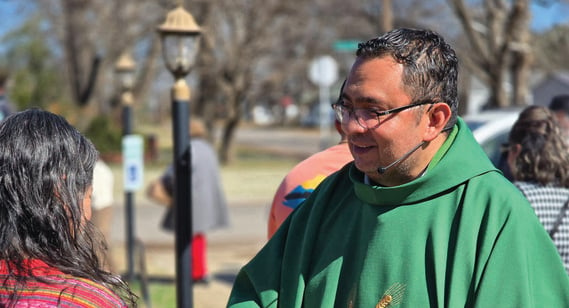
“The recent events in Venezuela represent a seed of hope for the country to return to the path of democracy and promote better opportunities for its people, in general, for the well-being of the Venezuelan people,” said Father Nerio Espinoza, a native of Venezuela and pastor of Saint Catherine of Siena Catholic Church in Pauls Valley.
Venezuela has been under a totalitarian/socialist regime since the late 1990s, led by Hugo Chávez Frías and then continued by Maduro, who was taken into custody by the U.S. government on Jan. 3 to face trial on charges of narco-terrorism, cocaine trafficking and weapons offenses.
Father Espinoza recalls many pressures and restrictions on Venezuelan people’s freedoms, including freedom of religion and worship.
“I recall that during my student days, explosive devices were detonated in the Cathedral of Mérida, incidents that have been repeated over the years in other churches,” Father Espinoza said.
Some priests have been threatened, including Cardinal Baltazar Porras Cardozo, who continues to support political prisoners in Venezuelan jails.
Freedom of speech is another of the freedoms curtailed by the regime. Many media outlets, including religious radio stations, have been shut down.
“The situation is tense that some priests have been threatened, and in general, every one of them should be very careful with the words they use and the messages they share,” Father Espinoza said.
The complex situation, due to the economic and humanitarian crisis, along with many other issues, triggered the largest migration exodus in recent decades, with around 8 million Venezuelans dispersed worldwide.
Porfirio Valera among them.
Valera arrived in the U.S. with his wife, Violeta, seeking a better quality of life, finding open arms in Pauls Valley. Family and friends gave them a warm welcome, and now, as a parishioner at Saint Catherine of Siena, he expressed hope after Maduro's capture.
“We need to maintain faith in God that Venezuela will overcome all obstacles,” he said.
Father Espinoza emphasized the need to maintain radical hope that promises are fulfilled in Jesus.
“It's not going to be easy for the country to improve, but there's a process of reconnecting with good values and respect for faith and commitment to good actions,” he said.
The message is to “keep faith in God, with Our Lady of Coromoto, patron of Venezuela, and Saint José Gregorio Hernández, that our prayers for a better Venezuela in peace are heard.”
The totalitarian regime didn't vanish with Maduro's capture. Many Venezuelans are cautious, as popular uprisings could trigger a more dangerous scenario.
"Our prayers are for world leaders to make decisions supporting peace, justice and strengthening institutions and democracy," Father Espinoza said.
“The message of Pope Leo XIV resonates, ‘The good of the beloved Venezuelan people must prevail over any other consideration.’”
Father Espinoza is not the only foreign priest to be the pastor of Saint Catherine of Siena Catholic Church. Father Joseph Duffy, from Salford, England, arrived in Oklahoma by the invitation of Bishop McGuinness in 1949. Father Espinoza, was born in Trujillo, Venezuela. He holds a degree in religious sciences from the Javeriana University in Colombia, and a bachelor’s and doctorate in philosophy from the Pontifical Gregorian University in Rome, Italy.
Serving the Saint Catherine community for nine years, Father Espinoza has also ministered to many Hispanic families.
“My message to the Hispanic community, often victims of social rejection, racism and discrimination, is to move forward, overcome fear, and seek God's peace that will give you strength,” he said.
“This community has been and will continue to be filled with values, playing important roles and missions in the Catholic faith.”
In this country, built by immigrants, too, Father Espinoza said, “It's essential not to be afraid, because in God's eyes, ‘I am like you before God’” (Job 33:6).
“Though our accents sound different and may give us away, we're people of good will,” he added, referencing Peter's recognition as a Galilean after denying Jesus (Matthew 26:73).
“Diversity is beautiful and powerful. We have different accents, ways of speaking, and a rich vocabulary that should fill us with confidence. Don't be ashamed of our language and accent; we're all God's children.”
Bella Gutiérrez is a freelance writer for the Sooner Catholic.