
Search
-
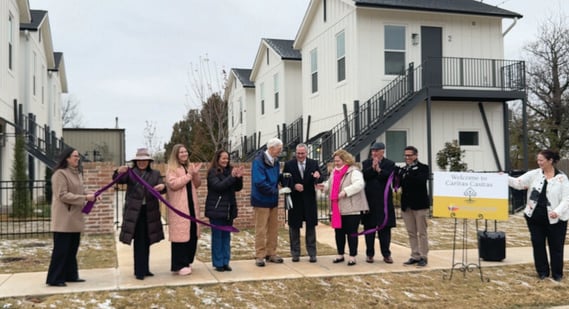 February 19, 2026Housing those in most need has always been a steadfast pillar of the Catholic Church.
In Oklahoma, that pillar remains, and is prominent, recognized clearly in recent efforts by Catholic Charities.
The organization has played a pivotal role in housing women in need in the Oklahoma City community for decades through the development of The Sanctuary Women’s Development Center, which has in turn led to the opening of Caritas Casitas, an affordable housing development in Stockyards City.
“One of the tasks that Archbishop Coakley has asked of Catholic Charities is ‘to go where others are not,’” said Patrick Raglow, executive director of Catholic Charities for the Archdiocese of Oklahoma City. “And so we are not doing shelters, because Jesus House, City Rescue Mission, City Care and Salvation Army are. We don’t need to compete with them. We pick up where they drop off, and we drop off where they pick up.”
Catholic Charities has a storied history in Oklahoma. In 1912, the foundation for Catholic Charities was laid with the founding of Saint Joseph’s Orphanage. In the following years, other institutions were opened to serve children, families and other people in need. Among these were a boardinghouse for young working women, a maternity home and Saint Ann’s Home for the Elderly.
In 1927, Catholic Charities expanded its services to include adoption, foster care and pregnancy counseling. Its mission was to make Christ’s love for all human beings a visible and living reality for those in need.
Among its many and varied services, Catholic Charities offers a day shelter for homeless women and children: The Sanctuary Women’s Development Center. With centers located in Norman and Oklahoma City, the sanctuary offers homeless and low-income women and children resources, providing support and advocacy to alleviate the effects of poverty within the community, as well as providing tools to overcome homelessness.
The program provides social services to homeless and at-risk women and their children including resource referral and assistance accessing services such as vocational and employment development, and life skills classes.
The Sanctuary Women's Development Center focuses on the needs of women who live in shelters, although services are also available to people who are at risk of becoming homeless. Trained social workers assess the personal strengths and needs of participants including health and nutritional status, income and benefits, mental health status, and vocational/employment concerns. The assessment also identifies legal, domestic violence, and child abuse issues or concerns.
The center offers a reprieve from the outside elements, access to showers and a laundry room, a computer lab, and food for those who come in hungry. As an outreach to low-income families living in the neighborhood, participants maintain a community garden, and all are welcome to tend the garden and pick the produce.
The Sanctuary Women's Development Center began as a program development at Our Lady of Guadalupe Catholic Church in Stockyards City in 2009. Most people do not know that Catholic Charities is part of the Homeless Alliance – a zero barriers entry shelter. Therefore, someone can go there and be a felon, sex offender, mentally unwell, intoxicated – any person experiencing homelessness.
“It provides women a place to take a shower and do laundry,” he said. “The first time they come in they are greeted with a smile, and every time thereafter they are greeted by name. They get access to a computer, work on a resume, get food and clothing, and it is one of the only – if not the only – feminine hygiene product places where they can get those things for free.
“Once they come in and build enough trust, we invite them into case management – and by trust I mean they trust us – to address the conditions that brought them to us and hopefully get them into housing.”
For many years they operated out of that facility. They did a facility survey in 2015, and it was said that it was the least effective and attractive of all of their facilities from a building perspective, but the one most likely to see the hand of God.
They carried out a Capital Campaign, raising $5.5 million dollars, allowing them to later open a brand-new sanctuary in August 2024. In the $5.5 million is endowment monies to help sustain the facility long-term.
“Over the many decades, at least 1,400-1,500 women have gone from homelessness into housing,” said Raglow. “However, it’s a sad fact we could’ve gotten way more women out of homelessness and into housing if there was more housing in which to place them. Finally, Catholic Charities established its own corporation to focus on housing.”
That focus led to two subordinate corporations: Catholic Charities of the Archdiocese of Oklahoma City Housing Inc. and Catholic Charities of the Archdiocese of Oklahoma City Community Housing Development Organization.
Recently, Catholic Charities announced the opening of Caritas Casitas, an affordable housing development in Stockyards City. Inspired by the Latin word Caritas, meaning “Christian love of humankind,” and Casitas, the Spanish word for “little homes,” this development reflects Catholic Charities’ mission to provide safe, stable and welcoming homes for those in need.
The Casitas are a unique product called Boxabl: manufactured housing, but not like a mobile home.
The units are hyper-efficient, 367 square feet of living space, for an individual or a couple, or maybe a mother with an infant. They offer a full-size kitchen, washer and dryer unit and a full-size bathroom. Parishes have agreed to sponsor some of the furniture, furnishings, linens and pots and pans.
Caritas Casitas is a pocket community of 12 units on a 100 x 100 square foot lot, across the street from the sanctuary in Stockyards City. A $1.5 million dollar project, it will serve people who make 60% of the area median income or below cost $850.00 per month.
“We used these units in a very innovative way to actually create duplexes, so we could use the space as efficiently as possible,” said Yolanda Worth, director of housing for Catholic Charities. “This was the first time the city of Oklahoma City had used modular accessory dwelling units for the construction of a small development, so there was definitely a learning curve.”
Catholic Charities is working with the Diversion Hub, a collaboration where they are choosing the individuals that come from their program to come to their units. They provide all case management for that specific unit, as those individuals have very specific needs, and they will rent the units out for them.
Worth said throughout the process, they partnered with many organizations and parishes, a collaboration to sponsor the residents in each unit.
“The goal for the rest of the tenants is to teach them to get closer to sustainable independence,” Worth said. “We provide case management and budgeting, all free of cost from Catholic Charities as a support to the tenants.”
Raglow said that working to serve those in need, Catholic Charities has learned housing is the single most preventative thing to be done to address every single social determinant of health.
“Mental illness is easier to deal with if you are housed. More people are dealing with mental illness that are housed than are unhoused. Addiction issues are easier to deal with if you are housed and harder if you are unhoused. Medical issues are easier to deal with if you are housed.
“Literacy, food, security… everything is easier if you have housing security.”
Joanna Borelli is a freelance writer for the Sooner Catholic.